
Summary for Decision-Makers
Traditional chatbots follow predefined scripts. Conversational AI goes further by understanding intent, maintaining context, retrieving approved knowledge, and supporting business actions.
Human-centered conversations depend on six capabilities: intent understanding, context and memory, clarification, tone adaptation, workflow integration, and human handoff.
A five-layer architecture covering Channel, Understanding, Memory, Retrieval, and Guardrails helps enterprises create consistent, grounded, and secure interactions.
Human handoff and governance should be designed from the start so AI can recognize uncertainty, protect sensitive data, preserve continuity, and involve people when judgment is required.
Success should be measured through CSAT, FCR, AHT, and Containment Rate, together with AI quality metrics such as grounded response rate, clarification success, latency, and human override rate.
Enterprise conversational AI can recognize the words a customer types and still fail to solve the customer’s actual problem.
Many chatbots detect a keyword, return a policy or FAQ, and stop. The response may be relevant, but the user still has to repeat information, move to another channel, or wait for an employee to complete the request.
The gap usually appears because the system lacks context, conversation memory, workflow access, clarification logic, or an effective human handoff. It can generate a response, but it cannot maintain continuity or move the user toward resolution.
Most enterprises already use chatbots, yet many so-called AI assistants still frustrate customers instead of helping them. The words may make sense, but the interaction feels mechanical and incomplete.
Organizations are therefore moving beyond the question, “Should we use AI?” They are asking, “How can AI make digital interactions more useful, human-centered, and valuable?”
This guide explores the human side of intelligent conversations, including the design principles, five-layer architecture, use cases, metrics, and governance controls required to support both users and enterprise outcomes.
What Does “Talk to AI” Really Mean?
Quick Answer
In an enterprise context, talking to AI means interacting with a system that can understand intent, remember relevant context, retrieve approved information, clarify uncertainty, support authorized actions, and transfer the conversation to a human when necessary.
To talk to AI is not just about receiving an answer. It is about being understood.
When people contact a virtual assistant, they are usually trying to resolve a delayed order, update an account, complete an application, understand a policy, or recover from an urgent issue. The objective is not only speed. It is useful understanding followed by the right next action.
A traditional chatbot generally relies on fixed rules, menus, or decision trees. It works well when a request follows an anticipated path, but it may struggle when users provide incomplete information, change direction, or ask follow-up questions.
Conversational AI supports more flexible and context-aware interactions by combining language understanding, dialogue management, enterprise knowledge, and business integrations.
Consider a customer asking about a delayed order. A basic chatbot may quote the delivery policy. An intelligent assistant can retrieve the order status, explain what happened, offer the next action, and escalate the case when intervention is required.
The value does not come from making software pretend to be human. It comes from connecting language, data, workflows, and human oversight into one coherent experience.
The Human Side of Intelligent Conversations
Behind every AI interaction lies a simple human expectation: to be heard and understood.
A system does not need to experience emotion. It does, however, need to communicate clearly, respond appropriately, and remain transparent about what it knows and can do.
A technically relevant answer can still create a poor experience when the assistant ignores information already provided, responds confidently despite uncertainty, uses an inappropriate tone, or transfers the case without preserving its history.
True conversation design begins with the user’s experience. The goal is not to make AI sound human at all costs, but to make interactions clearer, more consistent, and more supportive.
At Titani, the human side of conversational AI means reducing unnecessary friction while keeping people involved where their expertise, authority, or judgment adds value.
Designing Conversations That Drive Outcomes
Every effective conversation can be designed around three connected dimensions: intent, emotion, and action.
These dimensions are what separate basic, scripted chatbots from intelligent assistants that actively solve problems and create measurable results.
1. Intent: Understanding What Users Truly Mean
Strong conversational AI interprets the user’s objective rather than reacting only to individual keywords.
A message such as “I need to change my plan” may mean upgrade, downgrade, pause, or cancel. A better assistant asks a targeted question:
“Would you like to upgrade, downgrade, pause, or cancel your current plan?”
Clarification is not a failure. It prevents incorrect assumptions.
The assistant also needs effective fallback handling. When it cannot determine the request, it should explain what information is missing, offer relevant options, or transfer the conversation instead of repeatedly saying, “I do not understand.”
2. Emotion: Responding with Sensitivity
Tone and emotional signals influence how users experience automation.
A system may detect language associated with frustration, urgency, uncertainty, or satisfaction and adjust its response. This does not mean the AI possesses empathy. It means the conversation has been designed around the user’s situation.
A customer reporting a failed payment should not receive an overly cheerful response. A better answer acknowledges the issue, explains what can be checked, and provides the next step.
Human-centered language should reduce stress and improve clarity. It should never make an unsupported answer appear more trustworthy.
3. Action: Moving Toward Resolution
A useful conversation should end with progress. AI must support action, not only provide information.
Depending on the use case, conversational AI may retrieve an order status, update an approved record, schedule an appointment, create a support ticket, trigger an approval workflow, or transfer the case to an employee.
Workflow integration turns the assistant from a language interface into an operational component. High-impact actions involving payments, contracts, account access, or personal data may require identity verification, explicit confirmation, or human approval.
For more complex processes, enterprises may use AI intelligent agents to coordinate tools and workflows.
When Intent, Emotion, and Action work together, conversations reduce effort, support resolution, and create measurable business value.
The Engine of Empathy: A Five-Layer Conversational AI Architecture
Behind a simple exchange is a connected architecture that manages language, context, knowledge, security, and business actions.
The five-layer model remains a practical foundation: Channel, Understanding, Memory, Retrieval, and Guardrails.
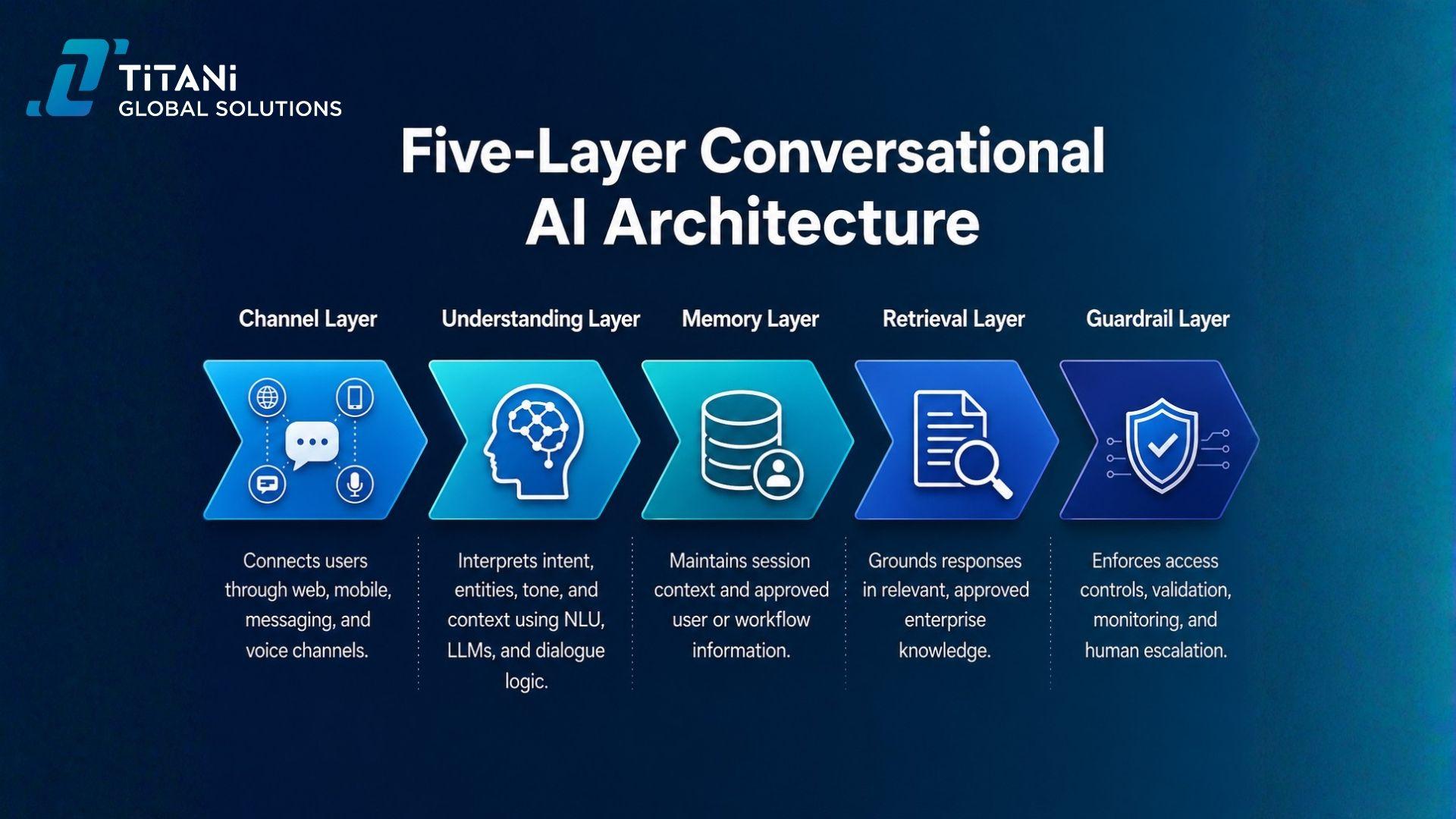
1. Channel Layer
The Channel Layer connects websites, mobile applications, customer portals, messaging platforms, voice systems, and contact-center interfaces.
Each channel may have different authentication, accessibility, privacy, and latency requirements. The objective is continuity.
When identity and permissions allow, a customer moving from a website assistant to human support should not need to restart the process. Relevant case information, verified details, and conversation context should move with the interaction.
2. Understanding Layer
The Understanding Layer moves beyond keywords to interpret what the user is trying to achieve.
It may combine Natural Language Understanding, language models, dialogue rules, and business logic for intent classification, entity extraction, clarification, confidence checks, and workflow selection.
When a user says, “I’m not sure this plan fits my needs,” a rigid bot may interpret the message as cancellation. A stronger system recognizes uncertainty and asks whether the user wants to compare options, review current features, or speak with an advisor.
3. Memory Layer
Meaningful conversations depend on memory. The Memory Layer preserves the context required to avoid unnecessary repetition.
It may include turn-level context, session memory, cross-session context for authenticated users, and approved enterprise data from CRM, ERP, ticketing, or identity systems.
Memory should not be treated as unlimited storage. Organizations need policies covering what information can be retained, why it is needed, who may access it, and how long it is stored. These controls should align with applicable privacy obligations, including relevant principles under the General Data Protection Regulation.
Memory makes an assistant more attentive. Responsible memory helps make it trustworthy.
4. Retrieval Layer (RAG)
Understanding a question is only part of the task. The assistant must retrieve reliable information on which to base its response.
Retrieval-Augmented Generation, or RAG, retrieves content from approved sources and provides it as context for the model. Sources may include policies, product documentation, service manuals, knowledge articles, contracts, and structured business data.
Microsoft describes RAG as an approach for grounding model responses in proprietary content.
RAG can improve relevance, but it does not guarantee accuracy. A production retrieval layer still needs content ownership, access controls, version management, source tracking, and evaluation.
5. Guardrail Layer
The Guardrail Layer defines what the AI may access, communicate, recommend, and do.
Controls may include role-based permissions, sensitive-data redaction, content filtering, tool allowlists, output validation, confirmation rules, human approval gates, audit logs, and incident escalation.
A handoff may be triggered when the request is outside scope, clarification repeatedly fails, authentication cannot be completed, a high-risk action is involved, an integration fails, or the user asks for human support.
The employee should receive the transcript, verified information, actions already attempted, active intent, and reason for escalation.
Safety is not an optional feature added after deployment. It protects the user, the organization, and the credibility of the system.
Workflow Integration Across the Five Layers
Workflow integration operates across the architecture. Understanding identifies the action. Memory supplies context. Retrieval provides approved information. Guardrails verify permissions. The Channel communicates the result.
This allows the conversation to progress from:
“Here is the appointment policy.”
to:
“I found three available appointments. Would you like me to reserve Tuesday at 10:00 a.m.?”
Keeping Conversations Human and Consistent
Meaningful enterprise conversations continue to depend on three pillars: Consistency, Tone, and Collaboration.
Consistency allows users to move between channels without losing important context. Tone connects the organization’s values with the user’s situation and should define how uncertainty, errors, and frustration are communicated. Collaboration determines when AI should continue and when people should take over.
Human handoff is not evidence that the system has failed. It shows that the assistant recognizes the limits of automation. When escalation occurs, the employee should receive enough context to continue without asking the user to repeat everything.
Collaboration between AI and human teams combines automation with judgment, authority, and empathy where they are most valuable.
Where Conversational AI Creates Enterprise Value
Customer service, onboarding, and internal support remain practical entry points because they involve recurring needs, identifiable workflows, and measurable outcomes.
Customer Service
Conversational AI can help users check status, understand policies, troubleshoot common issues, update requests, and create service cases. The organization should define which requests the AI may resolve and which situations require identity verification or escalation.
For a broader commercial perspective, see Titani’s guide to the business value of conversational AI.
Customer and Employee Onboarding
An assistant can explain the next step, retrieve current instructions, check completion status, and route exceptions to the appropriate team. When source material is unclear, it should not invent a requirement.
Internal Support
Permission-aware conversational AI can support IT troubleshooting, policy questions, ticket creation, knowledge search, and service-status checks. Internal assistants should follow the same standards for grounding, data access, monitoring, and human oversight as customer-facing systems.
How to Implement Conversational AI in Five Steps
Conduct a conversation audit: Review transcripts, support tickets, repeated misunderstandings, and escalation points.
Select one controlled use case: Choose a process with a clear objective, reliable knowledge, manageable integrations, and measurable outcomes.
Define knowledge, actions, and boundaries: Document approved sources, system permissions, confirmation rules, and escalation conditions.
Pilot with real conversations: Test both successful paths and failures, including incomplete requests, authentication problems, and unavailable integrations.
Scale after production gates are met: Evaluate quality, security, privacy, reliability, latency, cost, human oversight, and business value.
A successful demonstration is not the same as a production-ready conversational AI system.
Measuring Success and Earning Trust
Human-centered conversational AI must deliver measurable business value while maintaining user trust.
Business and Customer Metrics
Customer Satisfaction (CSAT): How users evaluate the interaction or outcome.
First Contact Resolution (FCR): Whether the issue is resolved during the first interaction.
Average Handling Time (AHT): The time required to resolve cases, including those transferred to employees.
Containment Rate: The percentage of eligible conversations completed without human transfer.
Containment should not be used alone. A system can prevent users from reaching an employee while still delivering poor outcomes.
AI Quality Metrics
Enterprises should also track grounded response rate, incorrect answer rate, clarification success, conversation abandonment, escalation context completeness, human override rate, response latency, and tool success rate.
Metrics should be segmented by use case, channel, language, and risk level. A positive overall average may conceal a serious problem in one workflow.
Governance and Transparency
Performance demonstrates the value of automation, but governance determines whether that value can be sustained.
The NIST AI Risk Management Framework organizes AI risk-management activities around Govern, Map, Measure, and Manage.
The EU AI Act also establishes requirements and transparency obligations for relevant AI systems, depending on the use case and role of the organization.
A practical governance model should address transparency, data access and retention, knowledge ownership, retrieved sources, tool calls, human approvals, quality testing, incident handling, and accountable owners.
AI should communicate what it can and cannot do and provide a clear route to human support. Transparency provides a stronger foundation for trust than making the system appear human.
Frequently Asked Questions
What Is the Difference Between a Chatbot and Conversational AI?
A traditional chatbot usually follows predefined rules or scripted flows. Conversational AI can interpret natural language, maintain context, retrieve information, clarify uncertainty, and support more flexible interactions.
Can Conversational AI Remember Previous Conversations?
Yes, when the architecture and governance model allow it. Organizations should define what the system may remember, why it is required, how long it is retained, and who may access it.
When Should Conversational AI Transfer a User to a Human?
Transfer is appropriate when the request requires judgment, falls outside the approved scope, repeatedly fails clarification, involves sensitive actions, encounters a system failure, or when the user asks for a person.
Conclusion: The Future of Conversational Advantage
The future of conversational AI is not about replacing people. It is about improving how organizations listen, respond, and provide support.
Customer service, onboarding, and internal support offer practical starting points because they combine recurring needs, identifiable workflows, and measurable outcomes.
As organizations mature, conversational AI can evolve from a response tool into an integrated business capability that connects users with knowledge, supports workflows, and brings human teams into the conversation at the appropriate moment.
When designed responsibly, talking to AI becomes more than a transaction. It becomes an exchange that reflects the organization’s standards, values, and commitment to the people it serves.
At Titani, we combine human-centered conversation design with enterprise data, workflow integration, security controls, and responsible oversight.
Connect with Titani to discuss how conversational AI could support customer service, onboarding, or internal operations.